
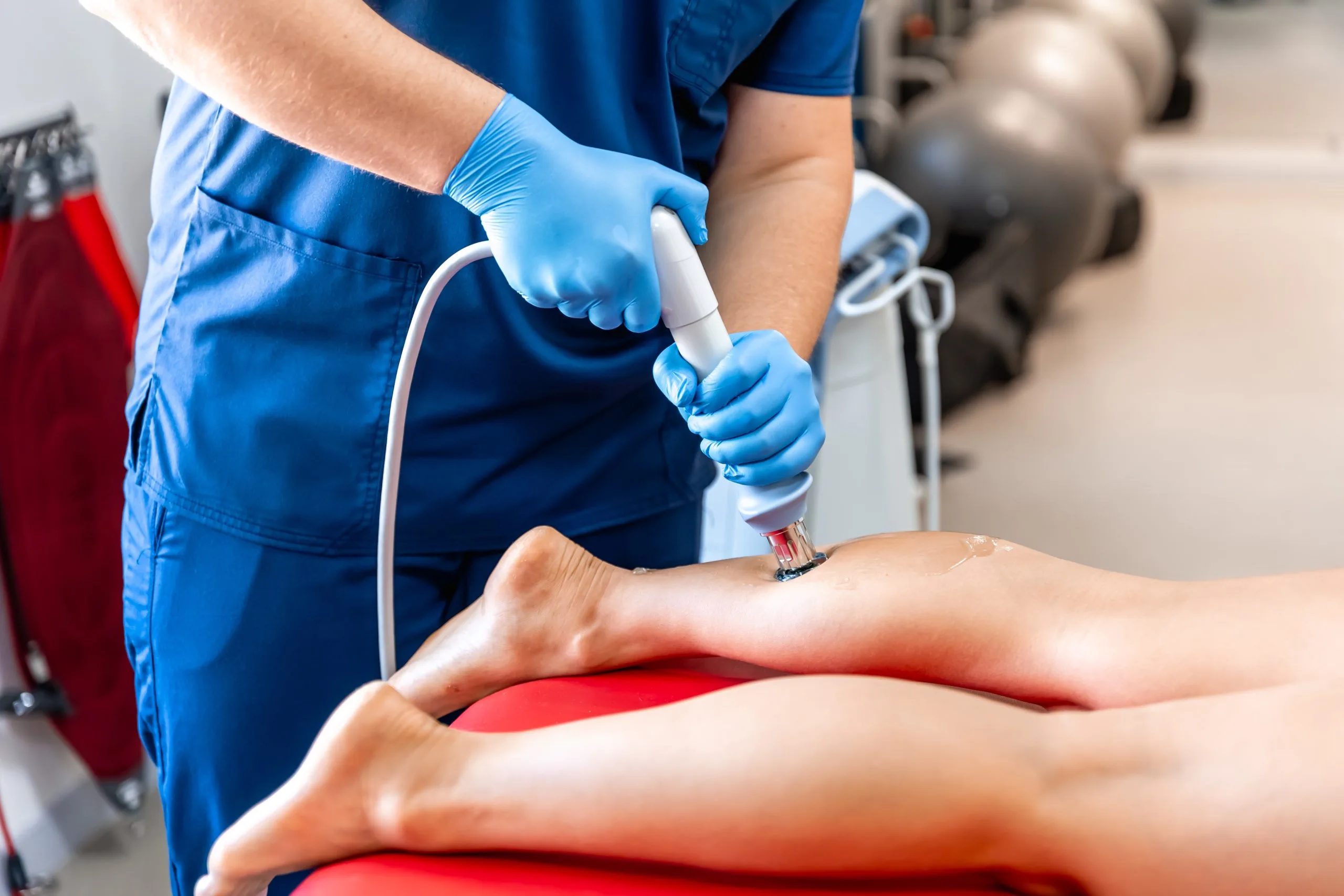
The best shockwave therapy for Achilles tendonitis is typically focused shockwave therapy, as it penetrates deeply enough to target the tendon itself. Radial shockwave therapy may be more suitable for widespread inflammation or superficial tenderness. At Restore Podiatry & Laser Center in Hicksville, NY, our team selects the type of shockwave therapy based on your specific tendon problem.
The Achilles tendon connects your calf muscles to your heel bone, handling an enormous load every time you walk, climb stairs, or push off to run. When that tendon becomes irritated or develops small areas of breakdown, you get Achilles tendonitis – stiffness and pain along the back of the ankle or right where the tendon meets the heel.
Chronic cases are often called tendinopathy, meaning the tendon fibers have become disorganized and poorly supplied with blood. That’s why these injuries drag on for months: the tissue isn’t inflamed so much as stalled in the healing process.
Shockwave therapy uses high-energy acoustic pulses delivered through the skin to stimulate healing in stubborn soft tissue. It’s the cornerstone of our “no needles, no surgery” approach to active recovery – no incisions, no lengthy downtime. You lie down, the applicator is placed over the painful area, and the pulses do the work.
The pulses create a controlled mechanical stimulus inside the tendon. That signal increases blood flow and new blood vessel growth, breaks down scar tissue that limits movement, triggers the release of growth factors, and helps reset pain signaling in nerve endings around the tendon. In short, it wakes up a tendon that has stopped repairing itself.
Shockwave has become a mainstay for chronic Achilles tendinopathy precisely because rest, ice, and stretching frequently aren’t enough once the tendon has degenerated. It addresses the root cause – the damaged tissue – rather than masking symptoms. Results are strongest when shockwave is paired with a loading program: the therapy stimulates repair, and controlled exercise directs how the new tissue organizes.
At Restore Podiatry & Laser Center, we offer several shockwave technologies so your plan can be truly customized.
Focused shockwave concentrates energy at a set depth, like a magnifying glass focusing light. For a thickened Achilles tendon or a deep, localized painful spot, this precision matters – it targets the damaged zone directly while sparing surrounding tissue.
Radial shockwave spreads energy outward from the applicator head and works closer to the surface. It’s well-suited to tight calf muscles, superficial tenderness, and broad areas of irritation feeding into the tendon.
StemWave is an advanced acoustic wave system that uses gentler energy to attract and activate the body’s own healing agents. It’s an option for patients whose tendon pain has persisted despite months of conservative care.
Focused waves go deep and narrow; radial waves stay shallow and wide. For a tendon sitting under skin and fat with visible thickening, focused energy reaches the problem. For calf tightness and surface soreness contributing to it, radial is often the better fit. Used together, they cover both layers.
Low-energy therapy: more comfortable, no anesthesia needed, usually given over several visits
High-energy therapy: stronger stimulus for severe or stubborn cases, typically used fewer times
Chronic, well-established tendinopathy generally responds better to higher-energy protocols; sensitive or early-stage cases start lower and build up
Our team determines the appropriate energy level for your specific condition.
Most Achilles plans run three to six sessions, spaced about a week apart. Each visit is brief – often just 10–15 minutes – and you walk in and out.
There’s no downtime in the surgical sense. Most patients resume normal daily activities immediately, though they feel mild soreness or warmth over the tendon for a day or two. High-impact activity is usually paused briefly after each session, then reintroduced gradually.
You may be a good candidate if you:
Have heel or tendon pain lasting more than six weeks, often months
Have already tried stretching, activity changes, rest, or ice without success
Are an active individual or athlete looking to get back in the game quickly
Want to avoid injections, medication, or surgery
Some patients notice less morning stiffness after two or three sessions. Deeper tendon remodeling continues for weeks after the final visit, so improvement often continues to build for two to three months.
Do your prescribed calf and eccentric heel-drop exercises consistently
Avoid sudden mileage or intensity spikes
Wear supportive shoes; consider custom orthotics if your mechanics overload the tendon
Prioritize sleep and hydration – both genuinely affect tendon repair
Report any new sharp pain instead of pushing through it
Follow the activity modifications outlined by Dr. Davinder Bhela
Shockwave therapy can be an effective non-surgical option for people dealing with persistent Achilles tendonitis or tendinopathy, particularly when conservative treatments haven’t provided enough relief. Whether focused, radial, or StemWave therapy is appropriate depends on the location, severity, and characteristics of your tendon problem.
At Restore Podiatry & Laser Center, we evaluate these factors to develop a treatment plan tailored to your needs, with the goal of reducing pain, supporting tendon healing, and helping you return to normal activity safely.
About the Author
Dr. Davinder Bhela, DPM
August 25, 2026