
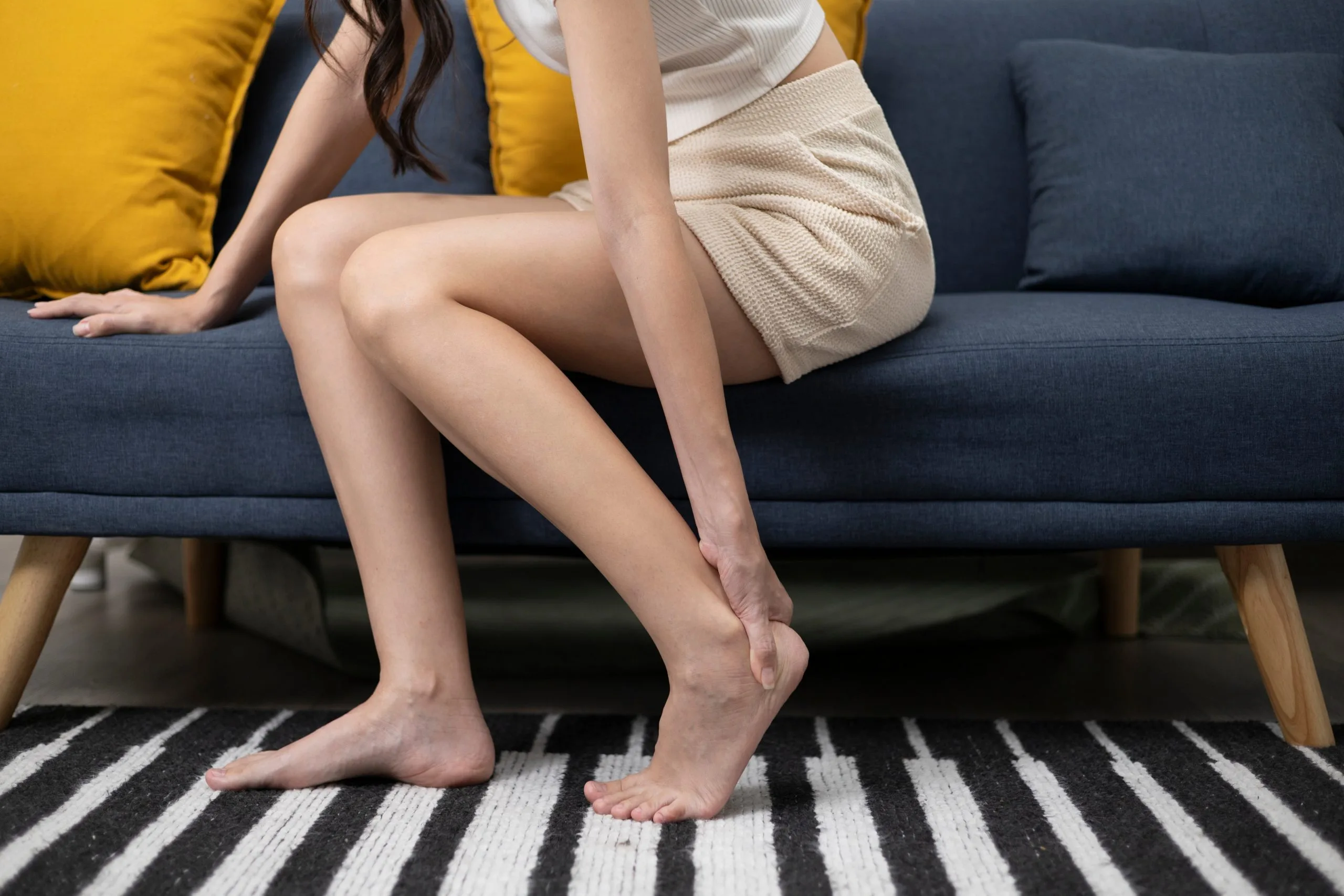
Shockwave therapy is a non-invasive, no-needle treatment that uses acoustic energy pulses to trigger your body’s own healing response in a painful tendon – typically requiring only 3 to 6 short in-office sessions with no downtime. At Restore Podiatry & Laser Center in Hicksville, NY, our team uses shockwave technology to help runners, weekend athletes, and active seniors get back on their feet without surgery, medication, or injections.
This article walks you through exactly how shockwave therapy works, what a session feels like, how long healing takes, and how to know whether you’re a good candidate.
The Achilles tendon is the thick cord connecting your calf muscles to your heel bone. It’s the largest and strongest tendon in the body – and one of the most abused. Every step, jump, and push-off loads it with several times your body weight.
Achilles tendonitis develops when repeated stress creates microscopic tears faster than the body can repair them, leaving the tendon irritated, inflamed, and eventually degenerated. It’s common in runners who suddenly increase intensity or mileage, weekend warriors, and anyone whose job keeps them on their feet.
Shockwave therapy delivers rapid pulses of acoustic (sound) energy through the skin and into the injured tendon. Despite the name, there are no electrical shocks, no needles, no incisions, and no anesthesia – a handheld applicator is pressed against the back of the heel and ankle and sends energy waves into the tissue for several minutes.
Those pulses create a controlled micro-stress that the body interprets as a fresh injury. In response, your system restarts the healing cascade – essentially turning a chronic injury back into an acute one your body knows how to heal. In other words, shockwave doesn’t mask pain. It restarts repair.
Not all shockwave devices are the same, and matching the right type to the right tendon problem matters. Our Hicksville office offers two approaches:
Focused shockwave concentrates energy at a specific depth inside the tissue – like a magnifying glass focusing sunlight to a precise point. Ideal for deeper, localized problems such as the exact spot where the Achilles inserts into the heel bone. Surface tissue is spared while the trouble spot receives the strongest dose.
Radial shockwave spreads energy outward from the applicator in a cone shape, with its strongest effect closer to the surface and coverage over a wider area. The sensation is a strong, rapid tapping. Well suited to the calf muscles, paratenon sheath, and surrounding soft tissue.
Many patients do well with a combination – radial waves to loosen and prepare surrounding tissue, focused waves to drive healing into the precise point of degeneration.
Here’s what happens inside the tendon after treatment:
Increased blood flow. Acoustic pulses stimulate angiogenesis – the growth of new small blood vessels – bringing oxygen and nutrients to a poorly supplied area.
Reactivated healing cells. Mechanical stimulation signals tendon cells to produce new, healthy collagen, the protein that gives tendons strength and elasticity.
Breakdown of scar and calcium deposits. Chronic cases often involve disorganized scar tissue and, in some cases, calcium buildup or bone spurs at the heel. Shockwave energy helps break these apart so the body can reabsorb them.
Release of growth factors. Treatment promotes natural substances that drive cell regeneration and tissue repair.
Pain signal modulation. The pulses overstimulate pain-transmitting nerve fibers, reducing pain signals – which is why many patients notice relief before the tendon has fully remodeled.
Reduced inflammatory chemicals. Treatment shifts the local chemical environment away from the inflammatory state that keeps a tendon irritable.
This is a biological process, not a temporary numbing effect. Results tend to build over weeks rather than appearing instantly – and they tend to hold.
No needles, no surgery. Nothing is injected, and nothing is cut.
No anesthesia or sedation. Sessions are performed fully awake in the treatment chair.
No downtime. You walk in, walk out, and drive yourself home. Most people return to work the same day.
Short appointments. Each session typically lasts only 10–15 minutes, with just a handful of minutes of treatment over the tendon.
Addresses the root cause. Unlike a pain reliever or a brace, shockwave targets the degenerated tissue itself.
High success rate. Studies show strong results for chronic tendon issues that failed other treatments.
Works alongside other care. It pairs naturally with stretching programs, custom orthotics, and activity modification.
A step before considering surgery. For many chronic cases, shockwave offers a conservative option to try first.
Insertional Achilles tendonitis – pain at the very back of the heel where the tendon anchors to bone – is notoriously difficult to treat. Eccentric heel-drop exercises that help mid-portion cases often aggravate insertional pain by compressing the tendon against the heel bone. Stretching can make it worse, and rigid shoe backs rub the tender spot raw.
This condition frequently involves calcification: hardened calcium deposits inside the tendon near its attachment, sometimes with a heel spur or a Haglund’s deformity (a bony enlargement) at the back of the bone.
Precision targeting. Focused shockwave directs energy to the insertion point at a controlled depth, reaching the exact tissue interface where the damage lives.
Deposit breakdown. Mechanical energy fragments calcium deposits so the body can clear them – something stretching and rest simply cannot touch.
No compressive loading required. Patients who couldn’t tolerate a traditional strengthening program can begin shockwave right away, then reintroduce loading as pain settles.
Insertional cases sometimes need a slightly longer course of care, and patience matters – the tendon-bone junction remodels slowly. But for people who have tried everything else, this is often the turning point, offering a path to recovery that previously required surgery.
Your first step is a thorough evaluation with Dr. Davinder Bhela, including a physical exam and often diagnostic imaging to pinpoint the exact location and extent of the damage. During the procedure, you’ll sit or lie comfortably while gel is applied to the skin to transmit the acoustic waves. You’ll hear a loud clicking sound and feel a tapping or pulsing sensation.
The honest answer: it’s tolerable for the large majority of patients. You’ll feel a rapid tapping or thumping over the back of the heel – some describe it as a deep, achy knocking. Energy levels are adjusted throughout the session based on your feedback, starting lower and building as the tissue accommodates.
Afterward, some people notice mild soreness or a warm, flushed feeling in the heel for a day or two, similar to a deep tissue massage. That’s a normal sign the healing response has been switched on. Most patients walk out comfortably and resume their day, pausing high-impact activity for a short window after each session.
Most Achilles tendonitis patients complete 3 to 6 sessions, typically spaced about a week apart. That spacing gives your body time to respond before the next healing stimulus.
Your specific plan depends on:
How long you’ve had symptoms (chronic cases often need the full course)
Whether the problem is insertional or mid-portion
The presence of calcification
Your activity demands and goals
How your tendon responds after the first two sessions
Some patients feel noticeably better after session two. Others feel little change until the series is complete, then improve steadily over the following weeks. Both patterns are normal.
Tendons heal on a biological clock. Here’s a realistic timeline:
Weeks 1–3 (during treatment): Mild post-session soreness is common. Some patients report early reductions in morning stiffness. Continue light activity as directed; avoid ramping up mileage or intensity.
Weeks 3–6: Many patients notice a meaningful shift – less pain on those first morning steps, better tolerance for walking and stairs, reduced tenderness when pressing the tendon.
Weeks 6–12: Collagen remodeling is well underway, and the tendon is rebuilding stronger, more organized fibers. Guided strengthening becomes valuable here.
Months 3–6: Continued improvement is expected even without further treatment. Athletes typically resume full training in this window.
Two factors influence your pace: how long the tendon has been degenerating before treatment, and how well you support healing between and after sessions. Dr. Bhela will advise on activity modification – generally avoiding high-impact activities like running and jumping for a few weeks so the tendon can heal without re-injury.
Shockwave starts the repair. Your habits determine how well it finishes.
Modify – don’t eliminate – activity. Complete rest weakens tendons. Swap running for cycling, swimming, or an elliptical, then reintroduce impact gradually.
Follow the 10% rule. Increase distance or intensity by no more than about 10% per week. Most re-injuries come from doing too much, too soon.
Fix your footwear. Rotate out shoes with worn heels and compressed cushioning. For insertional cases, avoid stiff heel counters that press on the tender spot. A small heel lift can temporarily reduce tension.
Loosen the calves. Tight gastrocnemius and soleus muscles pull directly on the Achilles. Gentle, consistent stretching (adjusted or paused for insertional pain) reduces daily load.
Warm up properly. Five to ten minutes of easy movement beats static stretching alone.
Strengthen progressively. Once initial healing is underway, targeted calf and tendon exercises build resilience.
Support tissue repair. Adequate protein, hydration, and sleep matter for collagen synthesis – as does avoiding tobacco, which impairs blood flow.
Manage weight and surfaces. Extra body weight multiplies across every step. Softer surfaces and fewer steep hills reduce peak tendon strain.
Depending on your exam, Dr. Bhela may recommend:
Custom orthotics to correct the mechanics that overloaded the tendon – flat feet, overpronation, or an abnormal gait pattern. Without addressing the cause, tendonitis tends to return.
StemWave therapy, another regenerative acoustic option available at our practice.
Laser therapy to support circulation and comfort in the treated area.
Progressive loading exercises, introduced at the right stage – too early can irritate, too late can stall progress.
The Power Heel Program for patients whose heel pain involves more than the Achilles alone.
You may be a strong candidate if:
Your heel or tendon pain has lasted three months or longer
Rest, ice, anti-inflammatory medication, stretching, physical therapy, and shoe changes haven’t resolved it
You want to avoid injections or surgery and their recovery time
You can’t afford weeks of downtime for work, sport, or caregiving
You have insertional pain that hasn’t responded to standard exercise programs
Imaging or exam suggests calcification or tendon thickening
Shockwave isn’t appropriate for everyone. Pregnancy, active infection in the treatment area, some blood-clotting disorders or blood-thinning medications, and suspected complete tendon rupture require a different plan. A sudden “pop” with an inability to push off may indicate a rupture, which needs urgent evaluation.
Achilles tendonitis rarely improves on its own once it becomes chronic, because the tendon’s poor blood supply leaves healing stalled. Shockwave therapy restarts that process with acoustic energy – no needles, no incisions, no downtime – typically over 3 to 6 short sessions. Focused and radial options let treatment be matched to your specific problem, including hard-to-treat insertional cases with calcification.
Combine shockwave therapy with smart activity modification, proper footwear, and custom orthotics, and most patients see steady improvement over 6 to 12 weeks with continued gains for months afterward.
Schedule an evaluation with Dr. Bhela – call (516) 806-2200
About the Author
Dr. Davinder Bhela, DPM
July 28, 2026