
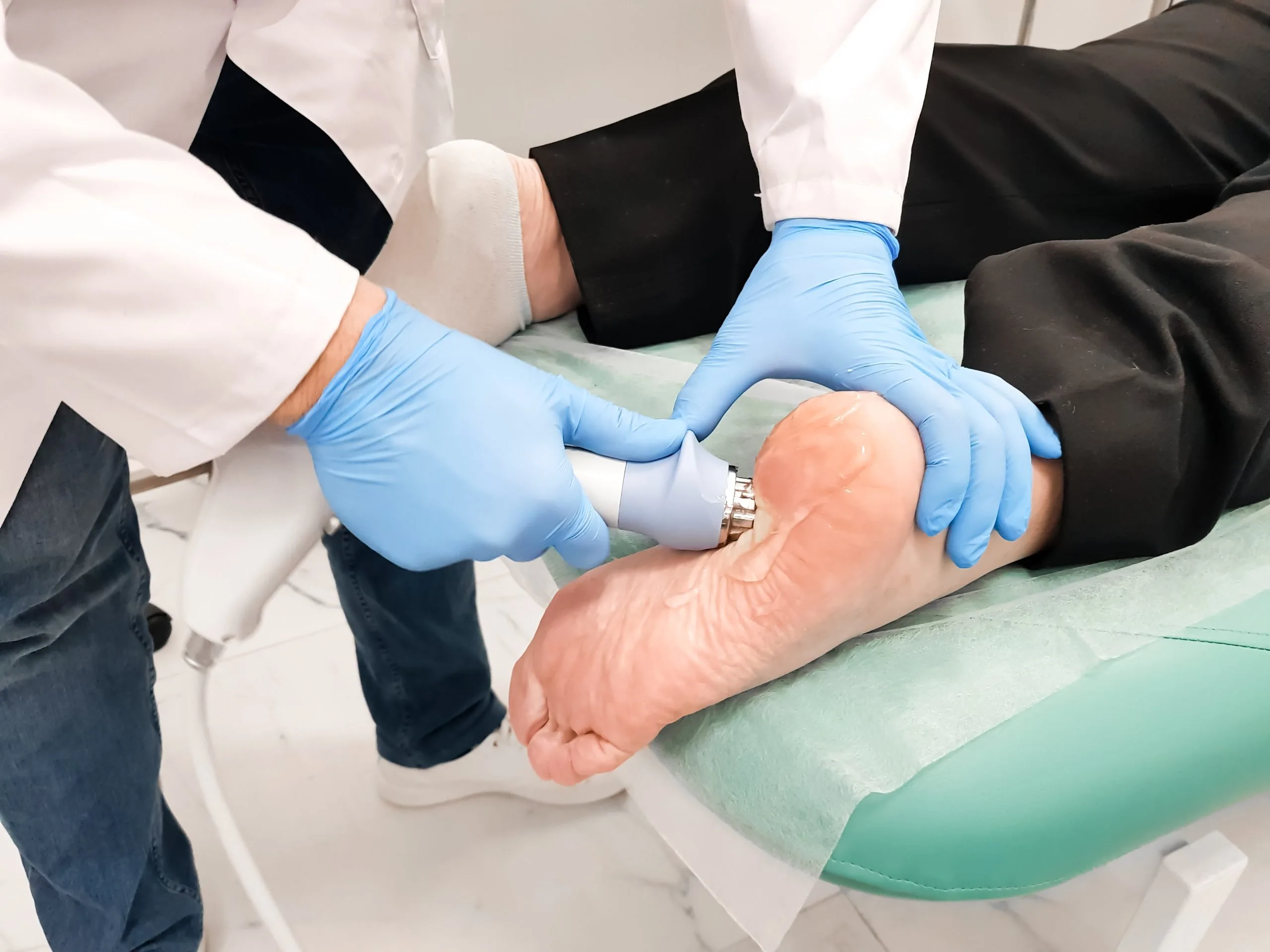
Two patients can walk in with the same diagnosis – stabbing pain at the bottom of the heel, worst with the first steps in the morning – and respond very differently depending on which acoustic wave is used, how deep it penetrates, and how precisely it’s aimed.
At Restore Podiatry & Laser Center in Hicksville, NY, our team offers focused and radial shockwave therapy – so the technology is matched to your heel, rather than your heel being matched to whatever single machine happens to be in the room.
Plantar fasciitis is an overuse injury of the thick band of tissue running from your heel bone to the base of your toes. Repeated strain creates tiny tears, and over time the body’s repair process stalls out. Chronic plantar fasciitis isn’t really “inflammation” in the classic sense – under a microscope it looks like degenerated, disorganized tissue with poor blood supply. That’s exactly why anti-inflammatory pills, rest, stretching, icing, and orthotics often stop working after a while.
Shockwave therapy takes a different approach. Instead of numbing pain or suppressing inflammation, it deliberately provokes a healing response in tissue that has gone quiet – no needles, no incisions, no anesthesia, no downtime.
There are two main families of devices – all available in our Hicksville practice:
1. Radial pressure wave therapy (RSWT). Produces a pressure wave that spreads outward from the applicator head in a cone shape. Energy is highest at the skin surface and decreases with depth.
2. Focused shockwave therapy (FSWT). Generates a true shockwave that converges at a targeted depth inside the body. Energy is lowest at the skin and highest at the focal point – the opposite energy profile of radial.
The simplest way to picture the difference: radial is a floodlight, focused is a laser pointer. Radial covers a wide area at moderate intensity near the surface. Focused concentrates high energy into a small volume at a chosen depth. Both are legitimate, both have solid support in the medical literature – but they are not interchangeable.
Radial devices use a ballistic system: a projectile inside the handpiece is accelerated by compressed air and strikes a metal applicator on your skin, creating a pressure wave that radiates outward like ripples from a stone dropped in water.
Key characteristics:
Penetration depth: Generally effective in the first 1 to 1.5 inches (roughly 25–30 mm) of tissue, with peak energy at or just beneath the skin
Treatment area: Broad – one pass covers the whole heel pad and much of the arch
Wave profile: Slower rise time, lower peak pressure, longer pulse duration than a true shockwave. Technically a pressure wave rather than a shockwave, though “radial shockwave” is standard usage
Sensation: A rapid, percussive tapping – like a firm massage gun, but more intense. Most patients describe it as uncomfortable rather than painful
Guidance: Typically applied by feel, with the clinician palpating the tender area and using patient feedback to stay on target
Radial therapy shines when the problem is diffuse – sore heel and arch, fascia thickened along its length, or tight calf and plantar musculature. It’s also effective at releasing myofascial trigger points in the calf, which frequently feed into plantar fasciitis.
Focused devices generate energy through electrohydraulic, electromagnetic, or piezoelectric mechanisms. The wave is shaped by a reflector or lens so it converges at a defined point inside the tissue – the focal zone.
Key characteristics:
Penetration depth: Adjustable, commonly up to 4 inches (about 100 mm), with the operator selecting focal zone depth
Treatment area: Small and precise – the focal zone may be only a few millimeters wide and a couple of centimeters long
Wave profile: A true shockwave with extremely fast rise time (nanoseconds) and high peak positive pressure, followed by a negative pressure phase producing cavitation bubbles in the tissue
High energy density: Concentration at the focal point far exceeds radial therapy, triggering a more profound biological healing response
Sensation: A deeper, sharper thumping concentrated in one spot, adjustable up or down based on tolerance
Guidance: The focal point can be aimed at the exact origin of the fascia on the heel bone
Focused therapy is the tool of choice when pain has one clear epicenter – most commonly the medial calcaneal tubercle, where the plantar fascia attaches to the heel bone. That attachment sits deep, under a thick fat pad, and is the single most common source of pain in chronic plantar fasciitis. A radial device may reach it weakly; a focused device delivers full energy directly to it. It’s also ideal for chronic Achilles tendonitis and heel spurs.
The practical answer depends on where your pain lives, how long you’ve had it, and what your foot looks like structurally.
Across the research literature, both radial and focused shockwave therapy consistently outperform placebo for chronic plantar heel pain, with meaningful reductions in morning pain scores and functional improvements holding up at six- and twelve-month follow-ups. Head to head, the findings break down like this:
Focused shockwave therapy tends to perform better when:
Pain is sharply localized to the heel bone attachment
The condition has lasted longer than six months
Imaging shows fascial thickening at the insertion or calcification
A heel spur is present
The patient has a thicker heel fat pad, so surface-level energy won’t reach the target
Previous conservative care, including stretching and orthotics, has failed
Radial shockwave therapy tends to perform well when:
Pain is spread across the heel and arch rather than pinpointed
The condition is earlier-stage or moderately chronic
Calf tightness and myofascial trigger points are major contributors
The patient prefers a gentler sensation
A larger treatment field is needed
Combined or sequential use is increasingly common – radial to address broad myofascial tightness and circulation, focused to concentrate energy at the specific lesion. Having both modalities under one roof means the plan can be adjusted between sessions if your response suggests a change.
The final decision follows a thorough evaluation by Dr. Davinder Bhela, typically including a physical exam and diagnostic ultrasound imaging. Ultrasound lets us see the plantar fascia directly, measure its thickness, and pinpoint tears, inflammation, or degeneration. Beyond imaging and the pain map, real-life factors shape the recommendation:
Active athletes and runners. Shockwave generally doesn’t require you to stop training, though activity may be modified. Runners with a specific painful point at the fascial origin often do well with focused therapy.
Active older adults. For patients who want to keep walking, golfing, playing with grandchildren, or standing through a workday, shockwave avoids the downtime of more invasive options. Energy levels can be dialed to a comfortable range.
People on their feet all day. Nurses, teachers, retail workers, and tradespeople often have both a focal insertion problem and widespread arch fatigue – this group frequently benefits most from a combined approach paired with custom orthotics.
Patients with structural contributors. If flat feet, a high arch, or abnormal gait is loading the fascia, shockwave treats the injury but not the cause. Long-term relief requires addressing mechanics too.
Who is generally not a candidate. Shockwave is typically avoided during pregnancy, over open growth plates in children, in areas with active infection or open wounds, in people with bleeding disorders or on blood thinners, in the presence of certain tumors, or near implanted devices. A thorough evaluation determines suitability first.
Does it hurt? Most patients describe it as uncomfortable but tolerable – a deep thumping or tapping. Energy is adjusted to your tolerance, no anesthesia is needed, and discomfort stops when the session ends.
How long is a session? Brief. Most patients are in and out quickly and return directly to work or errands.
How many sessions will I need? Generally three to six, spaced about a week apart, depending on chronicity and response.
Is there downtime? No. You walk out on the same foot you walked in on. High-impact activity is often limited for a day or two after each session.
When will I feel better? Some patients notice improvement after the second session, with benefits continuing to build for weeks after the final session.
Will the pain come back? Shockwave addresses the injured tissue. If the underlying mechanical cause – footwear, gait, arch structure, training load – isn’t addressed, strain can return. That’s why orthotics and stretching are usually paired with treatment.
Can shockwave be combined with other treatments? Yes – frequently alongside orthotics, calf stretching programs, and other therapies at the Hicksville office.
Focused shockwave delivers precise, deep energy to a specific painful point and suits chronic, well-localized heel pain – especially with a spur or fascial thickening. Radial covers a wider, more superficial area and suits diffuse heel and arch pain with significant soft-tissue tightness. Many patients benefit from a plan drawing on both approaches.
What matters most is an accurate diagnosis, an appropriate protocol with enough sessions, and a provider with more than one tool available – and the expertise to know which to use.
About the Author
Dr. Davinder Bhela, DPM
July 28, 2026